
Running an Impact Profile on a Hypothetical Mating
A hypothetical mating is a pairing that has not happened. G1 Goldmine builds the pedigree the foal would have and analyses it exactly as it would a horse already on the ground.
This is the point of the platform for most breeders. Mating decisions have to be made years before there is any evidence about the foal, and often before there is much evidence about the stallion. Analysing the pedigree the mating would produce is the only way to bring data to that decision at the time you actually make it.
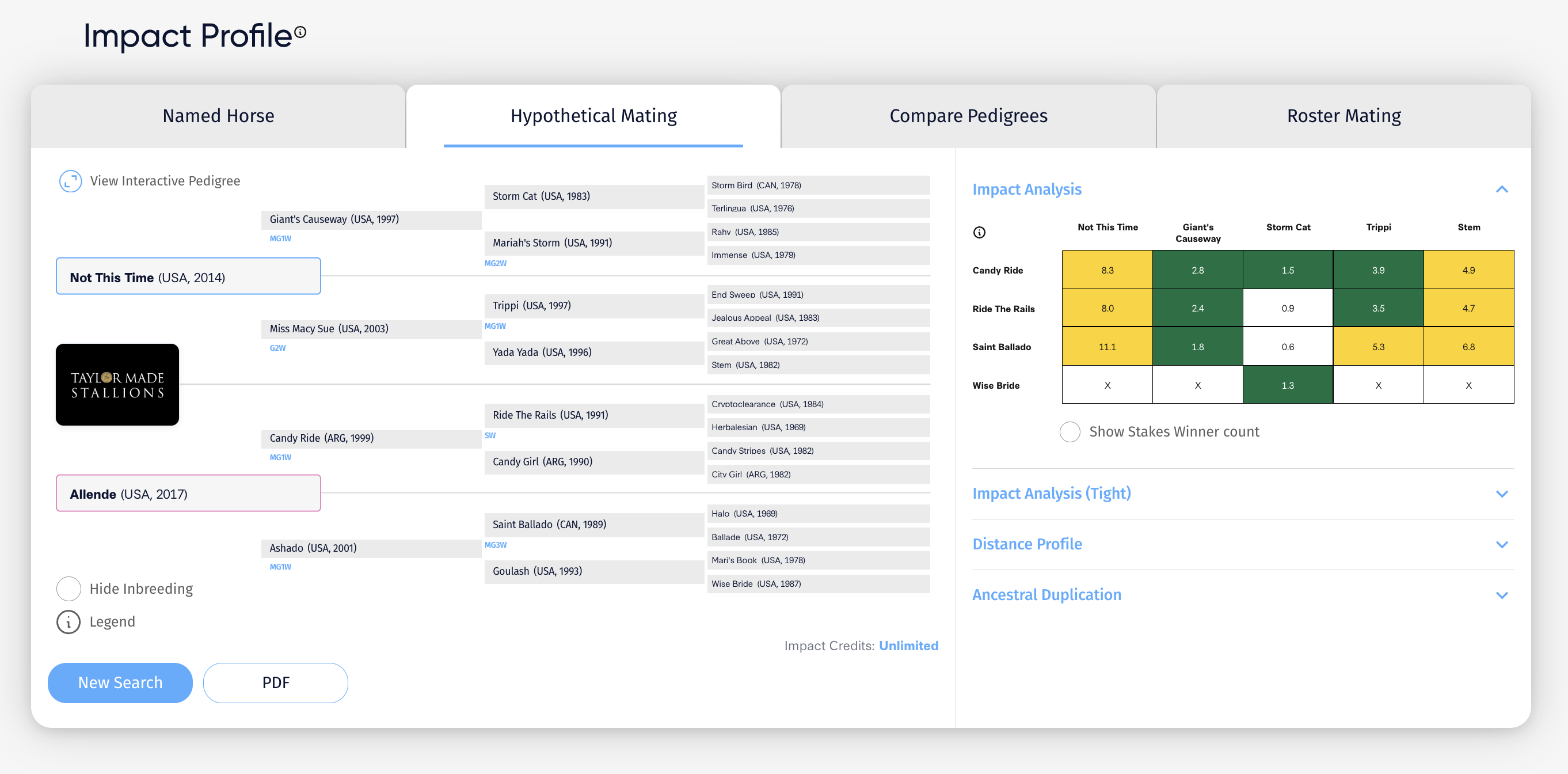
Running a hypothetical mating
- Open Impact Profile and click the Hypothetical Mating tab.
- Click Select Sire and choose the stallion.
- Click Select Broodmare and choose the mare.
The combined pedigree builds on the left, with the sire at the top and the mare beneath. Where the stallion stands at a farm listed on G1 Goldmine, the farm's branding appears between the two.
To test a different stallion against the same mare, change the sire and the analysis rebuilds. That makes it quick to work through a shortlist. To test a full roster in one pass, use Roster Mating.
Any male horse, not only commercial stallions
The sire field is not restricted to stallions standing publicly. You can test any male horse in the database, which matters in two situations.
First-season and unproven sires. A stallion with no runners has no record to judge, so pedigree analysis is the only evidence available. See Service fees, foal crops and first-season sires.
Horses not yet at stud. A colt still racing can be assessed against your mare before he retires and before his fee is set.
Four panels, not five
The analysis is the same as for a named horse with one exception. There is no Stakes Wins panel, because a hypothetical horse has no race record.
- Impact Analysis. The 20 key crosses the mating would create.
- Impact Analysis (Tight). The same crosses under a stricter matching rule. Pro only.
- Distance Profile. The distances at which the key ancestors' stakes winners actually won.
- Ancestral Duplication. The duplications the cross would create.
Reading the grid: a worked example
Take Not This Time over Allende. The grid puts five sire-side ancestors across the top and four dam-side ancestors down the left, giving 20 crosses.
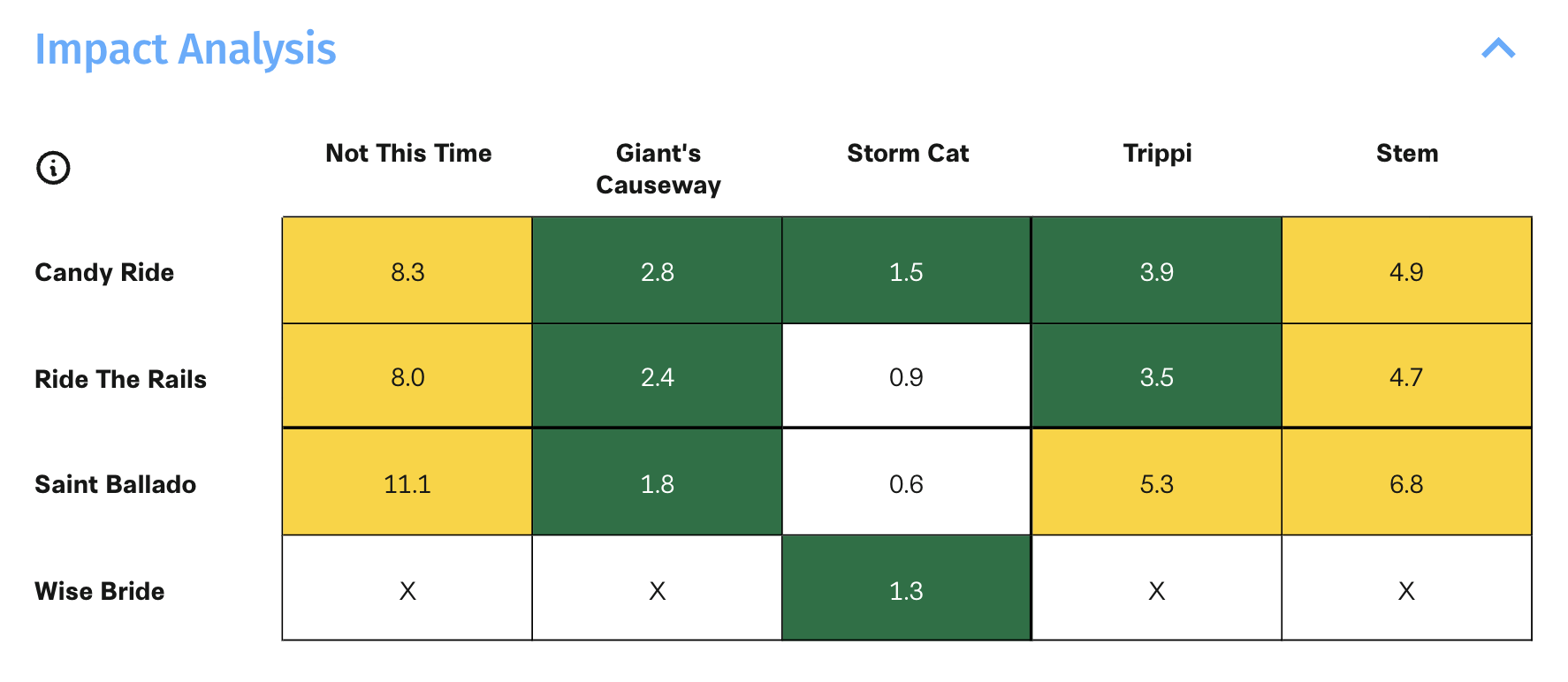
Know the reference point before reading any cell. The score compares what a cross actually produced against what its number of opportunities would predict, so 1.0 means it performed exactly as expected. Anything above that is outperformance.
Read down a column to see how one sire-side ancestor performs against the whole dam side. In this example the Not This Time column reads 8.3, 8.0 and 11.1, all gold, so those crosses have produced many times the expected number of stakes winners. The stallion himself works with every significant influence in the mare's pedigree, which is about as strong a signal as the grid produces.
The Stem column tells the same story, reading 4.9, 4.7 and 6.8.
Now look for the weak column. Storm Cat reads 1.5, 0.9, 0.6 and 1.3, mostly unshaded and sitting around the baseline. That influence contributes little to this cross. It does not undo the strength elsewhere, but it tells you where the mating is not being helped.
Read across a row to see how one dam-side ancestor fares against the sire side. The Saint Ballado row reads 11.1, 1.8, 0.6, 5.3 and 6.8, which is strong at both ends and weak in the middle.
A column or row that is consistently strong is worth more than a single high cell, because it means the ancestor works broadly rather than in one lucky combination.
What the X marks mean
In the same example the Wise Bride row returns X in four of five cells. That is not a poor result. It means too few comparable horses exist to compute a reliable figure for those crosses.
Treat a row of X marks as absence of evidence, not evidence of absence.
What to check before you commit
The duplications the cross would create. This is the thing that only exists once the two pedigrees are combined, and you cannot work it out from either parent alone.
Whether the strength is spread or concentrated. Gold across several rows describes a different mating from gold in one corner.
The distance profile against your programme. If you need a particular type of horse, check the mating points that way.
Stakes winner counts. Use Show Stakes Winner count on the grid. A strong score resting on very few horses is weaker evidence than a moderate one resting on many.
Comparing two matings
The question is rarely whether one mating is good. It is usually which of two is better. Use Compare Pedigrees to put two side by side.
What it cannot tell you
The analysis covers pedigree. It does not cover the physical match between the two horses, the mare's conformation or fertility, the stallion's fee against your budget, or how the resulting foal will sell.
Treat it as the evidence for the part of the decision pedigree can inform, and weigh the rest separately.